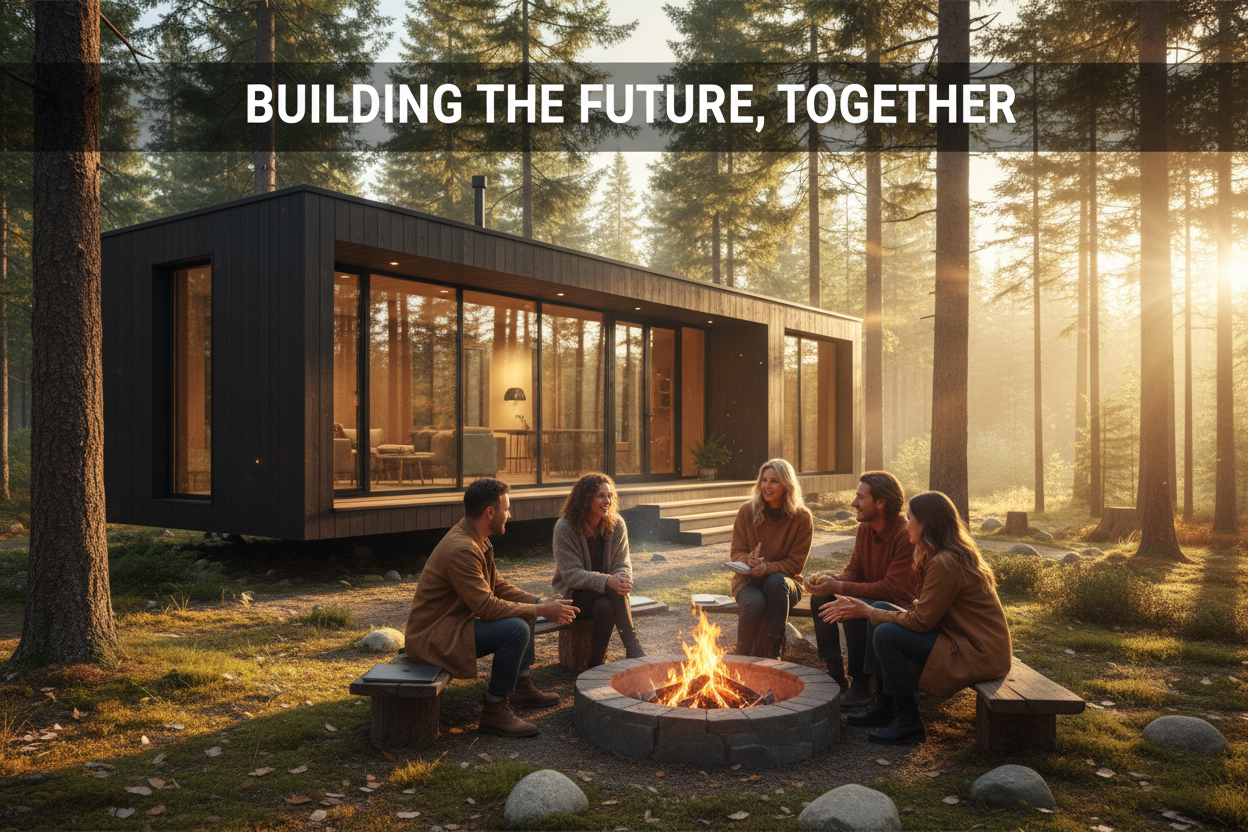
Most people building a business spend 90% of their time on the product and 10% on everything else. The ones who break through early flip that ratio — at least at the start. A recent CK Collective coaching session with a founder launching a modular cabin company surfaced lessons that apply to any startup, in any industry.
Here's what came out of it.
1. Niche Down Until It Feels Too Small — Then Go One Level Further
The instinct when starting a business is to cast a wide net. Home builder. Cabin builder. Modular. Custom. All of the above. The problem is that "all of the above" is a positioning statement that means nothing to anyone.
The coaching advice here was clear: pick the cabin market specifically, own it completely, and let the boutique positioning do the work. Less competition. Clearer customer. Stronger brand. You can always expand later — but you can't build a memorable brand while trying to be everything.
Takeaway: Where can you be the only, not just the best? The riches are in the niches. Pick one lane, go deep, and resist the urge to hedge until you have real traction.
2. Your "Why" Has to Be Emotional, Not Logical
A business plan full of market data and revenue projections will not get you through the hard days — and there will be hard days. What sustains founders is an emotional reason that goes deeper than profit.
The founder in this session articulated it well: helping someone get the custom space they've always dreamed of, delivered and built, without the nightmare of managing contractors. That's not a product description. That's a feeling. Lead with that.
Takeaway: Write your founder story. Not your resume — your reason. Why does this matter to you? What pain have you seen that you want to solve? Customers buy from people they believe in, and belief starts with a compelling "why."
3. Build the Audience Before You Build the Product
This was one of the most emphatic points in the entire session, and it runs counter to what most founders do. Don't wait until the product is ready to start talking about it. Start documenting the process now — the decisions, the setbacks, the discoveries, the behind-the-scenes reality of building something from scratch.
A podcast, a YouTube channel, a daily Instagram post, a blog — any of these, done consistently, builds an audience of people who are already invested in your success before you ever open for business. When launch day comes, you don't start from zero.
Takeaway: Content is a long game. Start now, before you feel ready. Document everything. The process is the product until the product exists.
4. Study Your Competitors' Websites Like a Student, Not a Critic
One of the most practical exercises in the session was a direct comparison of two competitor websites — one with a clean, minimal design that let imagery do the talking, and one that was text-heavy and harder to navigate. The lesson wasn't "one is good and one is bad." It was: identify specifically what works, what doesn't, and why — then make deliberate choices for your own site.
Professional photography. Clear service descriptions. A client questionnaire to qualify leads before a call. These aren't nice-to-haves. They're the difference between a site that converts and one that just exists.
Takeaway: Pick three competitors. Audit their sites. Write down what works, what doesn't, and what's missing that you could own. Then build your site with intention, not imitation.
5. Don't Seek Investors Before You Have Momentum
The founder in this session floated the idea of bringing in a partner or investor early to help fund a manufacturing facility. The advice was direct: don't.
Bringing in outside money or partners before you have traction means negotiating from weakness. You give up equity, control, and leverage at the exact moment when all three have the least value. Build first. Get your website live. Talk to customers. Make some sales. Then — when you have proof — investors are a tool, not a lifeline.
Takeaway: Bootstrap as long as you can. Every week you operate without outside capital is a week you retain full ownership of the upside. Prove the concept first. Fundraise second.
6. The 90-Day Reverse Timeline Is Your Best Planning Tool
One of the most useful frameworks in the session was building a 90-day reverse timeline — starting with where you want to be at the end of 90 days and working backwards to what needs to happen each week to get there.
This approach does something that forward planning doesn't: it forces you to confront the real sequence of dependencies. You can't launch a website before you have a name. You can't market a product before you have photos. Working backwards surfaces those bottlenecks before they surprise you.
Takeaway: Map your next 90 days in reverse. Define the end state. Then work backwards, week by week, identifying every prerequisite. Build that into a calendar and protect the sequence.
7. Do One Thing at a Time — Actually
This sounds obvious. It isn't practiced. The founder in this session was managing a full-time job, a new business launch, family responsibilities, and a dozen open questions simultaneously. The coaching advice: write down your top three priorities for the day. Work on one at a time. Do not move to the next until the current one is done.
The book Psycho-Cybernetics came up here — a classic text on how the self-image and subconscious goal-seeking mechanism work. The core idea: your brain is a goal-seeking system, but it needs a clear target. Scattered focus produces scattered results.
Takeaway: What are your three most important tasks today? Write them down before you open your email. Work in sequence. Finishing things matters more than starting them.
8. Talk to Real Customers Before You Build Anything Else
Market research doesn't mean reading industry reports. It means having ten real conversations with people who could actually buy what you're building — lake cabin owners, resort operators, developers — and listening to what they actually want, fear, and wish existed.
These conversations don't just validate your idea. They give you the exact language your customers use, which becomes the copy on your website, the hook in your content, and the pitch in your sales calls.
Takeaway: Before you finalize your offer, have ten conversations. No pitching. Just questions. What do they struggle with? What have they tried? What would their ideal solution look like? The market will tell you how to sell to it.
9. Protect Your Energy Like a Business Asset
Launching a company while holding down a full-time job is genuinely hard. The session didn't romanticize that. It addressed it directly: you need recharge practices built into your schedule — workouts, weekends that actually rest, breathwork, whatever works for you — or the whole thing collapses from the inside.
Burnout isn't a productivity problem. It's a sustainability problem. The founder who goes hard for six months and crashes doesn't beat the founder who goes at 80% consistently for three years.
Takeaway: Schedule your recovery the same way you schedule your work. What does your weekly recharge look like? If you can't answer that, it's not happening.
10. Consistency Beats Intensity — Every Time
The closing theme of the session was this: content takes time to compound. Websites take time to rank. Audiences take time to build. Relationships take time to develop. None of it happens in a burst of effort.
The founders who win are the ones who show up every day — posting, building, talking to customers, refining the product — long after the initial excitement has worn off. The War of Art captures this perfectly: the professional shows up regardless of inspiration. The amateur waits for it.
Takeaway: What does your daily non-negotiable look like? One piece of content. One customer conversation. One task moved forward. Stack those days and in 90 days you'll barely recognize where you started.
Putting It Together
Whether you're building cabins or consulting services or a creative agency, the fundamentals don't change much. Know your niche. Know your why. Build in public before you launch. Talk to real customers. Plan in reverse. Protect your energy. Show up every day.
The product matters. But the business around the product is what makes it survive.
CK Collective is a community for creative entrepreneurs and service-based business owners building smarter, more sustainable businesses.

Share:
Reset, Rebuild, Rise: What Breakup Recovery Teaches You About Building a Better Life