
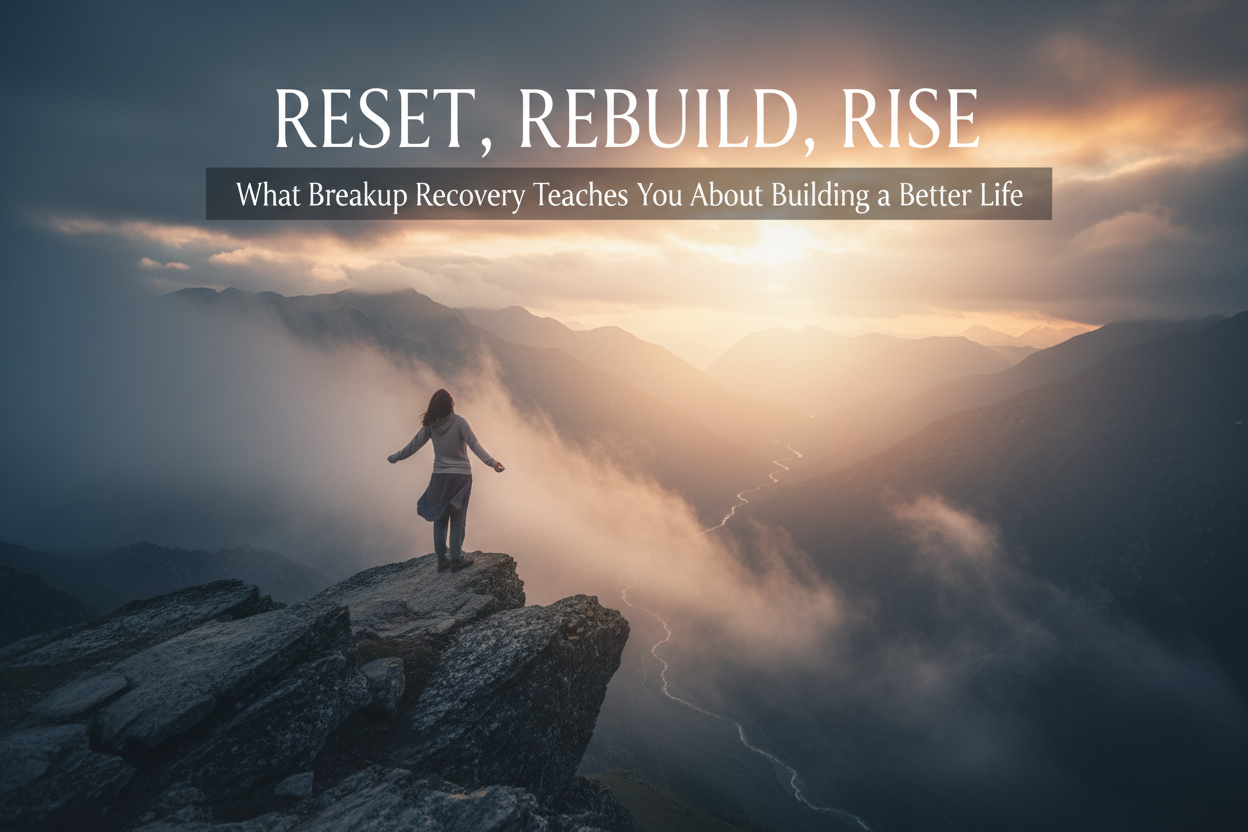
Reset, Rebuild, Rise: What Breakup Recovery Teaches You About Building a Better Life
A CK Collective Insight
Heartbreak is one of the most disorienting human experiences. It's also one of the most clarifying — if you use it right. A recent CK Collective coaching session went deep on breakup recovery, and what emerged wasn't just advice for healing. It was a blueprint for rebuilding yourself from the inside out.
These lessons apply whether you're coming out of a relationship, a failed business, a lost identity, or any season that left you starting over.
1. The Pain Is Normal — What You Do With It Isn't
The fear that an ex is moving on, the regret about what you could have done differently, the urge to reach out "just once more" — all of it is completely normal. The brain in grief behaves predictably. Knowing that doesn't make it hurt less, but it does make it less scary.
What separates people who come out stronger is not that they feel less. It's that they refuse to act on every feeling.
Takeaway: Normalize the pain without feeding it. Feelings are data, not directives. You don't have to do anything just because you feel it.
2. Cut the Neural Connection — Completely
Every time you check their profile, ask a mutual friend for updates, or replay old conversations, you're feeding a neural pathway that keeps you stuck. The brain processes social bonds similarly to addiction — and like any addiction, partial withdrawal is worse than none at all.
Full no-contact isn't cruelty. It's neuroscience. Delete the contact. Ask people close to you not to bring them up. Stop speaking about them entirely. You are literally starving a connection in your brain until it weakens.
Takeaway: Half-measures don't work here. Every "small" check-in resets the clock. Commit fully or don't bother — the middle ground just prolongs the suffering.
3. Dopamine vs. Endorphins — Know the Difference
This might be the most practically useful distinction in the entire session. Dopamine gives you a quick hit — scrolling, substances, junk food, video games — and then drops you lower than where you started. The brain recalibrates downward to compensate, leaving you in a worse emotional state than before.
Endorphins work differently. They're earned through effort — exercise, completing tasks, helping others, creative work — and they produce lasting elevation rather than a crash. The goal during recovery isn't to feel good fast. It's to rebuild a stable emotional baseline.
Takeaway: Every time you reach for an artificial dopamine hit, you're making the recovery harder. Chase endorphins instead. The run, the workout, the finished task — these compound. The scroll does not.
4. The Dopamine Detox Is a Reset, Not a Punishment
Thirty days of cutting artificial stimulation — social media, pornography, alcohol, recreational substances, mindless entertainment — isn't about deprivation. It's about returning your nervous system to baseline so that normal life feels good again.
When your dopamine system is chronically overstimulated, ordinary things — conversation, nature, a good meal, genuine connection — feel flat. The detox restores your ability to feel pleasure from real things.
Takeaway: A 30-day detox is a serious commitment. Write down your specific rules in advance. The goal is homeostasis — getting your emotional range back to a stable center so you can build from there.
5. The 6 Pillars Exercise: An Honest Self-Audit
One of the most powerful tools discussed was a simple self-assessment across six life categories: mental, physical, emotional, spiritual, academic, and financial. Rate yourself honestly from 1 to 10 in each area. Journal why. Then create a specific improvement plan for each.
This does two things. First, it shows you where you actually are — not where you wish you were. Second, it shifts your focus from the one thing you lost to the many things you still have the power to build.
Takeaway: Do this exercise this week. Be brutally honest. A 4 is a 4. The journal reasoning matters as much as the number — it's where the real insight lives.
6. Fill the Calendar — Eliminate Decision Fatigue
An empty day during emotional recovery is dangerous. When the schedule is unstructured, the brain defaults to whatever provides the fastest relief — and that's almost never what serves you.
The solution is simple: the night before, write down five things you will do tomorrow and five things you will not do. Schedule it in time blocks. Give your brain a script to follow so it doesn't have to improvise under stress.
Takeaway: Structure is self-care during hard seasons. You're not being rigid — you're removing the moment-to-moment negotiation that drains willpower and leads to bad decisions.
7. Selflessness Is One of the Fastest Routes Back to Yourself
Volunteering — at a soup kitchen, a senior center, anywhere people need help — does something that self-focused recovery work can't fully replicate. It gets you out of your own head and into genuine usefulness. It produces endorphins. It restores perspective.
When your inner world feels chaotic, being of service to others creates an anchor. You remember that you have something to offer. That your presence matters beyond one relationship.
Takeaway: Commit to one volunteer opportunity per week during recovery. One to two hours. It doesn't have to be grand. It just has to be genuinely for someone else.
8. Support Your Nervous System Physically, Not Just Mentally
Emotional recovery has a biological dimension that most people ignore. The nervous system is under real stress during grief — cortisol is elevated, sleep is disrupted, focus is fractured. You can't just think your way out of that.
Supplements like ashwagandha, magnesium, lion's mane, reishi, omega-3s, and vitamin D directly support the nervous system's ability to regulate during high-stress periods. This isn't a substitute for the inner work — it's the physical infrastructure that makes the inner work possible.
Takeaway: Talk to a healthcare provider about what's appropriate for you. But don't neglect the body during emotional recovery. Sleep, sunlight, movement, and targeted supplementation are legitimate tools — not shortcuts.
9. Become Someone — Don't Just Recover
The biggest reframe in the conversation: the goal of recovery isn't to get back to who you were before the relationship. It's to become someone new enough that going back would feel like a step down.
Self-improvement during this period isn't about getting the person back. It's about making yourself genuinely better — more disciplined, more self-aware, more purposeful — so that whatever comes next starts from a higher floor.
Takeaway: Ask yourself weekly: who am I becoming? Not who did I lose, not who do I want back — who am I becoming? Keep that question in front of you.
Putting It Together
Recovery — from a relationship, a setback, a lost version of yourself — follows a pattern. Eliminate the artificial. Build the real. Structure the days. Audit the self. Serve others. Support the body. Repeat.
None of it is comfortable. All of it works.
The goal isn't to feel better tomorrow. It's to be better in six months — and to look back at this season as the one where you finally did the work.


Share:
What Would You Tell the Version of You That Stayed Too Long?
Build the Audience Before the Product: Startup Lessons From a Modular Cabin Business